
Guillaume Marx, director of Bing until 1933, also acted as a consultant to other companies in Nuremberg.
In 1932, he proposed a red, white and blue striped livery to Tipp & Co, which went on to use it for a monoplane and a biplane intended for the British market.
Tipp & Co
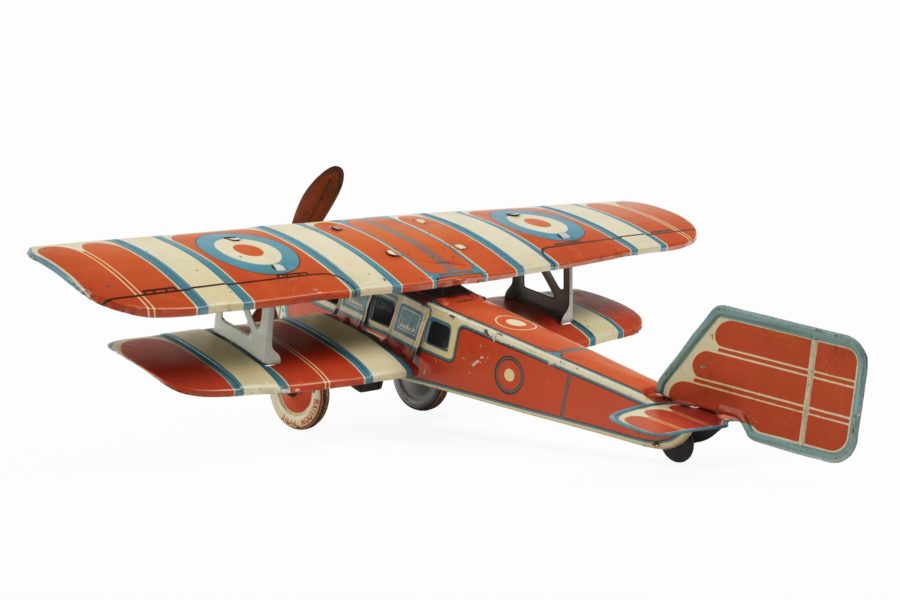
1932, lithographed tinplate, wind-up mechanism, rolls on the ground, 37.5 x 32.5 cm
Having had his business confiscated by the Nazis, Philipp Ullmann, owner of Tipp & Co, left Germany for England in 1933.
That same year, and for similar reasons, Guillaume Marx left Germany for France, where he went into partnership with the Kosmann brothers, the founders of Joustra; having been released from all obligations to Ernst Horn, the fence of Tipp & Co, he used this design for a small Joustra aeroplane of the F-POU type, fitted with a longitudinal spring mechanism.
Joustra
F-822
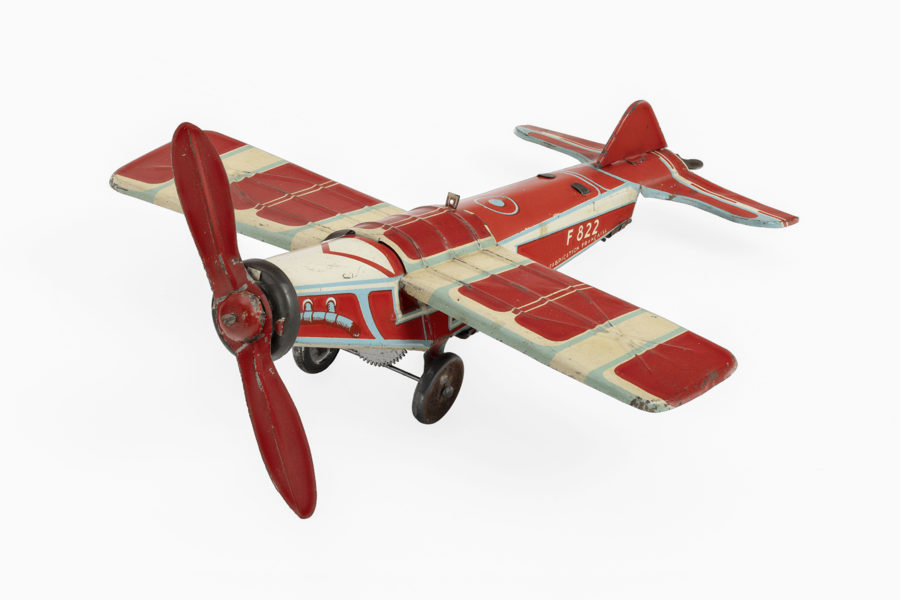
1939, lithographed tinplate, spring mechanism, the propeller turns, 24 x 21 cm
During the war, Guillaume Marx and the Kosmann brothers managed to escape Nazi persecution; production at Joustra resumed in 1946.
Philipp Uhlmann, who had founded Mettoy in Britain in 1933, reclaimed his business, placing it under his son’s management whilst retaining control of Mettoy himself; faced with the growing success of his German company, he sold Mettoy and returned to Nuremberg.